Washington – A new analysis published by the CCIA Research Center finds that Germany’s Network Enforcement Act (NetzDG), which mandates user-generated content removal on social media sites, is ineffective, costly, and anti-competitive. The results suggest that similar U.S. proposals would damage the digital economy through harms to competition, innovation, and consumers.
NetzDG attempts to reduce harmful content online by requiring social media networks to facilitate and review all user complaints and remove designated categories of content within 24 hours, with fines up to €50 million euros for non-compliance. The analysis shows that in 2022, 99.8% of reported content was either non-violative of NetzDG or duplicative. 84.4% of all reports were false positives, and 98.8% of the remaining reports were already caught by the social media sites’ community guidelines, wasting over 50 years of user time reporting content.
The findings also show that NetzDG resulted in just 5,138 incremental content takedowns at four leading social media sites. Compliance costs estimated from NetzDG-mandated transparency reports were between $1,741 and $5,116 per incremental takedown, with a broader cost to the German economy of €20.4 million (or $22.25 million), which is about $4,336 per incremental takedown. The costs harm competition and innovation by disproportionately impacting smaller social media sites and startups.
The Computer & Communications Industry Association has advocated for tech policy that advances competition and innovation for over 50 years.
The following can be attributed to the study’s co-author, CCIA Director of Research and Economics Trevor Wagener:
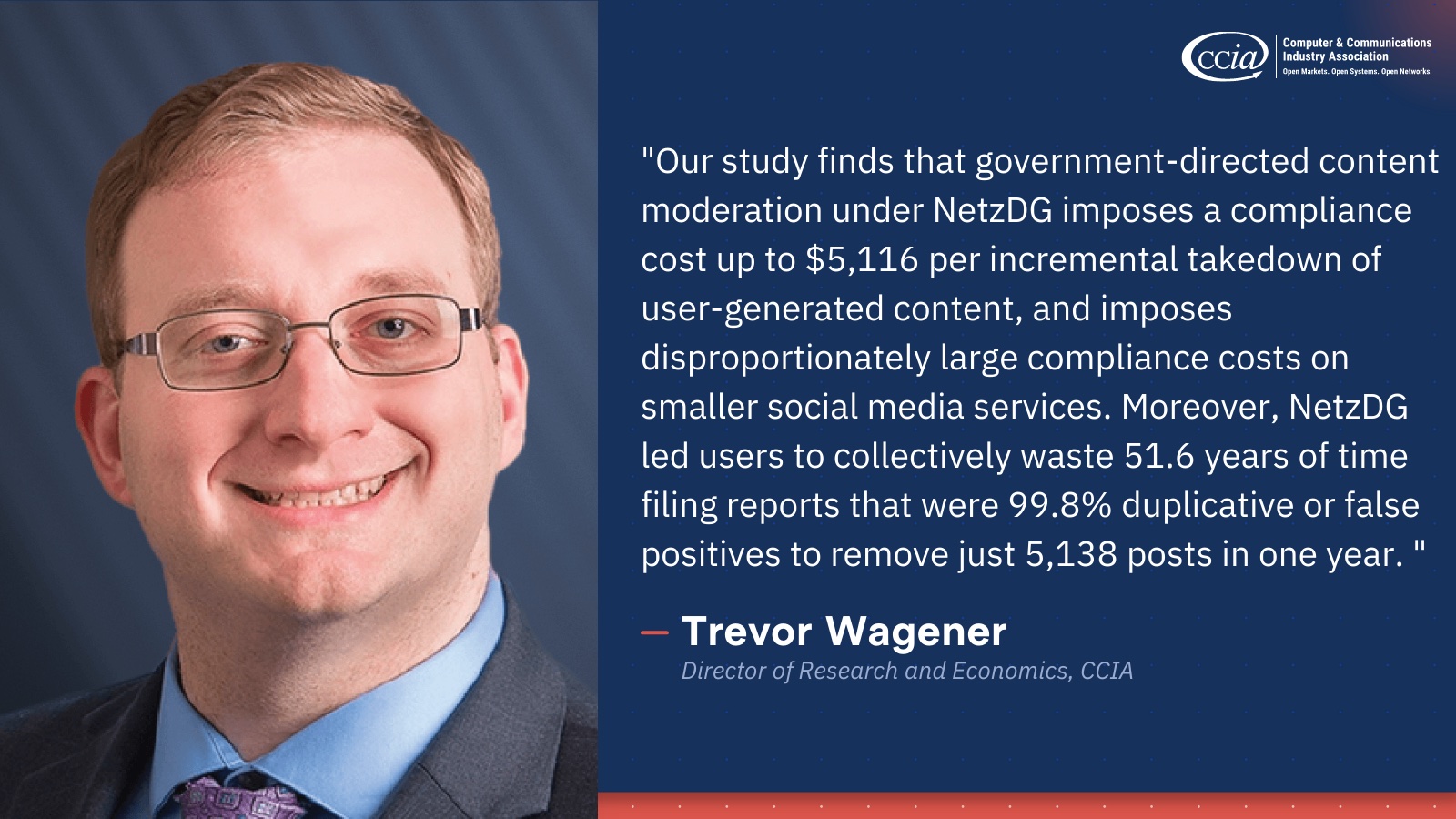
“Our study finds that government-directed content moderation under NetzDG imposes a compliance cost up to $5,116 per incremental takedown of user-generated content and imposes disproportionately large compliance costs on smaller social media services. Moreover, NetzDG led users to collectively waste 51.6 years of their time filing reports that were 99.8% duplicative or false positives to remove just 5,138 posts in one year. Lawmakers considering policies modeled on NetzDG should take heed.”