
Section 230 of the Communications Act (Section 230) importantly places legal accountability on creators of speech, rather than those who merely display it. It also allows digital services to safely moderate content to protect kids and keep the internet safer. Nevertheless, some in Congress continue to attack this important law.
Although much attention focuses on how repealing Section 230 would make the internet less safe and useful, there are also severe financial implications. The enormous financial costs of Section 230 repeal to investors result from removing the legal protections that underpin the $2.6 trillion digital economy and its 8.9 million American jobs.
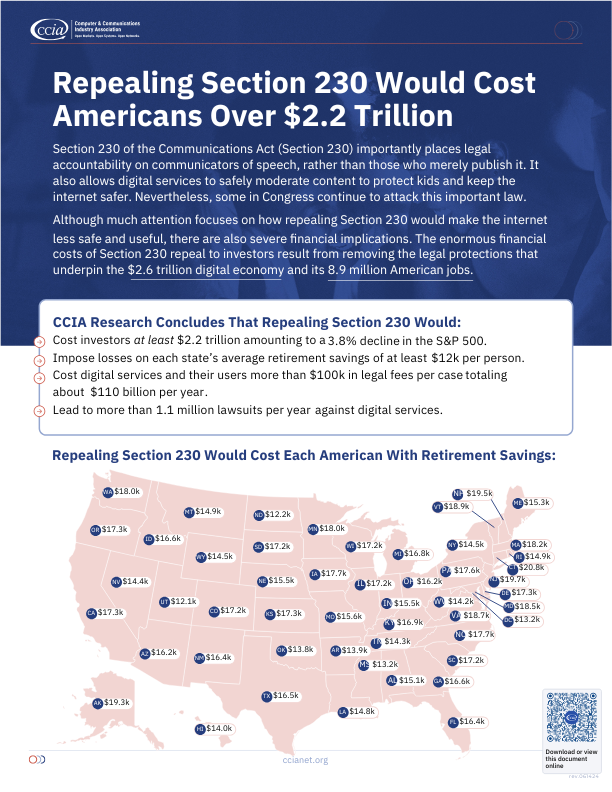
CCIA Research Concludes That Repealing Section 230 Would:
- Cost investors at least $2.2 trillion amounting to a 3.8% decline in the S&P 500.
- Impose losses on each state’s average retirement savings of at least $12k per person.
- Cost digital services and their users more than $100k in legal fees per case totaling about $110 billion per year.
- Lead to an estimated 1.1 million lawsuits per year against digital services.
Repealing Section 230 Would Cost Each American With Retirement Savings Over $12,000 in Each State:
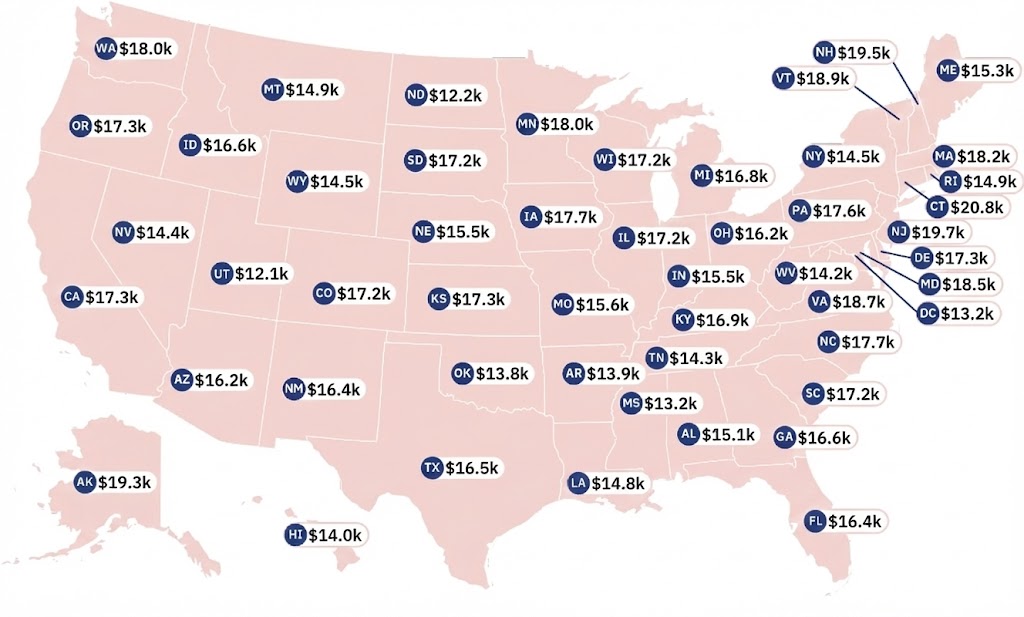
| State | Cost | State | Cost | State | Cost |
|---|---|---|---|---|---|
| Alabama | $15,100 | Kentucky | $16,900 | North Dakota | $12,200 |
| Alaska | $19,300 | Louisiana | $14,800 | Ohio | $16,200 |
| Arizona | $16,200 | Maine | $15,300 | Oklahoma | $13,800 |
| Arkansas | $13,900 | Maryland | $18,500 | Oregon | $17,300 |
| California | $17,300 | Massachusetts | $18,200 | Pennsylvania | $17,600 |
| Colorado | $17,200 | Michigan | $16,800 | Rhode Island | $14,900 |
| Connecticut | $20,800 | Minnesota | $18,000 | South Carolina | $17,200 |
| Delaware | $17,300 | Mississippi | $13,200 | South Dakota | $17,200 |
| D.C. | $13,200 | Missouri | $15,600 | Tennessee | $14,300 |
| Florida | $16,400 | Montana | $14,900 | Texas | $16,500 |
| Georgia | $16,600 | Nebraska | $15,000 | Utah | $12,100 |
| Hawaii | $14,000 | Nevada | $14,400 | Vermont | $18,900 |
| Idaho | $16,600 | New Hampshire | $19,500 | Virginia | $18,700 |
| Illinois | $17,200 | New Jersey | $19,700 | Washington | $18,000 |
| Indiana | $15,500 | New Mexico | $16,400 | West Virginia | $14,200 |
| Iowa | $17,700 | New York | $14,500 | Wisconsin | $17,200 |
| Kansas | $17,300 | North Carolina | $17,700 | Wyoming | $14,500 |
The Broad Impacts of Repealing Section 230
In the absence of Section 230, digital services hosting user-created content, including everything from online reviews to posts on social media, would risk constant litigation. Continuing to provide services optimized for user experience would require massively increased legal expenses, estimated below using conservative assumptions.
Endless Litigation With Real Costs
Research from CCIA shows that popular digital services owned by S&P 500 companies host about 1.1 trillion new user-created posts and comments each year.
Even if just one post or comment in a million led to a lawsuit, digital services could face over 1.1 million lawsuits per year following a Section 230 repeal.
A single lawsuit reaching discovery typically costs over $100K in fees, and sometimes much more. If companies face 1.1 million lawsuits, that’s $110 billion in legal costs annually.
Example:
- Users post trillions of pieces of content on popular digital services each year.
- About 1% of content is actioned under terms of service.
- Absent Section 230, both moderating and failing to moderate such content creates legal risks for digital services.
Killing Startups:
Young startups have limited capital runway and cannot endure such legal costs. Even if they ultimately prevail in court, small sites have gone out of business over exorbitant legal fees.
Legal Costs Would Be Paid By Ordinary Americans:
This financial burden would not only hurt tech companies, but also impact ordinary Americans investing in the stock market. A perpetual $110 billion decrease in free cash flow for companies listed on the S&P 500 and included in most common ETFs held by ordinary investors and retirement plans could reduce market capitalization by $2.2 trillion, a 3.8% drop in the S&P 500. This would affect millions of Americans’ retirement savings, potentially reducing their savings by an average of $12k or more.
The Harms of Repealing Section 230:
- Negatively impact the stock market and personal retirement savings.
- Decimate user-generated content.
- Create a significant barrier to entry for new tech startups.
- Overwhelm the court system with new cases, tripling federal caseloads.
- Increase legal costs for digital services.


