Washington – The Computer & Communications Industry Association submitted comments to the Office of the U.S. Trade Representative (USTR) detailing the harms of foreign digital trade barriers to U.S. exporters and U.S. economic competitiveness.
The comments were in response to USTR’s review of “Unfair and Non-Reciprocal Foreign Trade Practices,” conducted in response to the Administration’s America First Trade Policy Presidential Memorandum and the Reciprocal Trade and Tariffs Presidential Memorandum. In the comments, CCIA highlights the harms to U.S. firms caused by a wide range of priority digital trade barriers in key markets and the need for engagement and negotiations to address these barriers.
The comments include an annex with a recently-released factsheet summarizing a forthcoming study by the CCIA Research Center, that highlights estimated costs to U.S. businesses of the European Union’s (EU) digital regulations that target leading U.S. technology companies— potentially costing an average of $430 million per year for a single large U.S. company to comply. Across the five largest U.S. technology companies, this amounts to a staggering $2.2 billion annually. These regulations also expose U.S. companies to an estimated potential financial exposure, based on opportunistic litigation and inadvertent non-compliance of between $4.3 billion to $12.5 billion annually, per company.
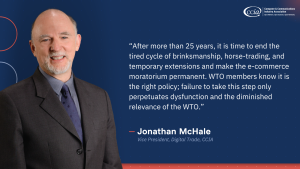
The following quote may be attributed to Jonathan McHale, Vice President of Digital Trade at CCIA:
“Over the past decade, a rising tide of digital trade barriers has imposed significant financial harm on U.S. firms, undermining their ability to compete in foreign markets. By restricting cross-border trade in digital products and services, these measures undermine the foundation for the modern economy and a key source of U.S. competitiveness. As USTR identifies priority issues for engagement in the coming months, these obstacles to digital trade should be a focus for negotiations, with the primary goal of removing these barriers and supporting fair and flowing trade with foreign partners.”