Washington – The OECD has announced that countries with digital services taxes in place have agreed to extend the current pause on the taxes through 2024 while work continues on implementation of global tax reform. This extension is critical as the OECD and the participating countries craft guidance on implementation of the 2021 Two-Pillar Solution to Address the Tax Challenges Arising from the Digitalisation of the Economy. This agreement was part of an Outcome Statement released this week and endorsed by 138 countries that identified remaining deliverables of the Two-Pillar Solution.
However, it is noticeable that Canada (which does not yet have a DST in place) joined Belarus, Pakistan, Russia and Sri Lanka in not supporting the extension. Canada has previously confirmed that it intends to proceed with its own digital services tax, despite committing not to introduce such measures under the 2021 agreement.
The United States Trade Representative has investigated similar digital taxes and found the taxes discriminate against U.S. tech companies and are actionable under U.S. law. USTR would be justified in pursuing a similar investigation with respect to Canada and has previously opposed the Canadian DST legislation.
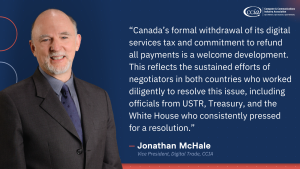
The following can be attributed to CCIA Vice President for Digital Trade Jonathan McHale:
“We are pleased with the continued progress on implementation of the global tax reform agreement, and the recognition by 138 countries that more time is needed to finalize remaining items under the framework. The extended pause on digital services taxes will enable parties to more effectively complete this work without introducing trade irritants.
“Disappointingly, Canada did not support this critical step to enable the OECD to further its important work, and continues to pursue the same flawed taxes others have now paused. As a responsible stakeholder, Canada should be taking steps forward to implement the global tax reforms and abandon plans to introduce a digital services tax in the future.
“Unfortunately, this action does not come in a vacuum— Canada is becoming an increasingly hostile market for U.S. exporters. In addition to the digital services tax developments, in recent months Canada has pursued a protectionist digital agenda targeting a broad range of U.S. suppliers. If Canada continues to act in opposition to bilateral trade interests, the U.S. government should address these distortive measures through various enforcement or consultation avenues available under U.S. law and relevant trade agreements.”