

The Korea Fair Trade Commission’s (KFTC) October 21 response (in Korean) to reporting on an Information Technology and Innovation Foundation (ITIF) study offers three explanations for higher penalties on American companies: larger firms with larger cases, different statutes with different ceilings, and a relevant-sales formula. It warns against an “averages trap.” CCIA’s separate study, also published in the past week, already examines several objections that a simple comparison of averages would invite. The KFTC’s statement does not address those findings.
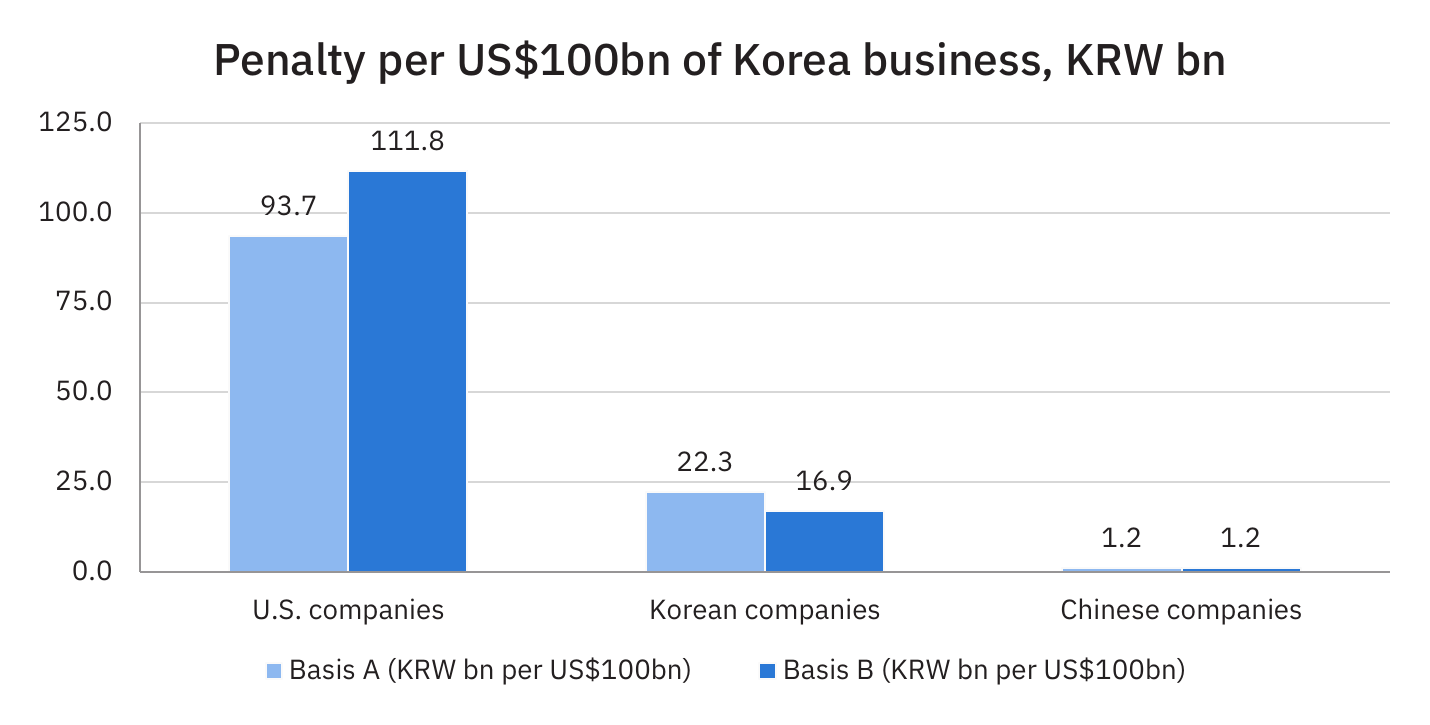
Our study compiled 3,453 respondent entries across 1,203 published decisions covering 2016 through 2025. American companies accounted for 22.8 percent of assessed penalty value, approximately $1.3 billion. Relative to their estimated Korean business activity, U.S. companies faced penalties 4.2 to 6.6 times the Korean rate. That comparison accounts for the enormous difference in the two groups’ economic presence in Korea.

U.S. companies do 4.4 percent of the Korea business of the three groups combined and bear 22.8 percent of the penalty value. Source: CCIA, The KFTC’s Uneven Hand (October 2026).
The KFTC argues that the Korean average includes violations of other statutes with lower surcharge ceilings and minor violations by small businesses. CCIA’s analysis separates legal categories and uses statistical controls for industry and year. The estimated U.S. respondent’s assessment remains 5.1 times the Korean respondent’s after those controls. A separate decision-level analysis, comparing within provision class and year and controlling for multinational status, finds penalties 2.3 to 2.5 times as large.
Qualcomm cannot explain away those findings. Excluding that company, the controlled respondent-level estimate remains 4.4 times the Korean level. Restricting the descriptive comparison to abuse of dominance and unfair business practices, U.S. penalties are 24 to 38 times the Korean rate per dollar of estimated Korean business, and 7 to 12 times with Qualcomm removed.

Within the same provisions, where U.S. and Korean respondents face the same statutory ceilings, the gap is widest. Source: CCIA, The KFTC’s Uneven Hand (October 2026).
These tests establish that invoking Qualcomm as an outlier or different statutory categories cannot dismiss our study’s evidence. The KFTC would need to demonstrate how remaining differences in affected sales and seriousness explain the disparities that survive these comparisons. Its release supplies no alternative statistical analysis showing that they do.
The release’s emphasis on “relevant sales” raises a more fundamental question: how does the Commission decide which sales are relevant?
The KFTC’s examples put surcharge-to-relevant-sales ratios at 2 percent for Coupang, 1.8 percent for Naver, and 3 percent for Kakao (2023), the Kakao Mobility dispatch decision. Similar percentages cannot establish equal treatment when the boundaries of the underlying revenue bases are themselves disputed. A regulator can impose a conventional percentage on an excessively broad base and still produce an excessive penalty. The formula’s existence says nothing about whether the same standards govern its inputs. Reciting the rule cannot resolve a dispute about how it is applied.
Between the announced amount and the written decision, the KFTC raised Google’s 2021 surcharge by 8 percent and Coupang’s by 16 percent by extending the sales period, and cut Kakao Mobility’s 2024 surcharge by 79 percent and the mobile carriers’ by 15 percent by narrowing the base. A formula applied the same way to every respondent would not move overwhelmingly in one direction by nationality. The KFTC’s own Korean examples shown in its release illustrate the concern. Kakao Mobility’s 2023 surcharge of KRW 27.1 billion was annulled in full on appeal in May 2025, and in October 2025 the Supreme Court reversed the judgment that had upheld Naver’s KRW 26.6 billion. Coupang’s KRW 162.8 billion stands while its appeal proceeds.

Change between the announced surcharge and the written decision, twenty large decisions with a reported provisional amount. Source: CCIA, The KFTC’s Uneven Hand (October 2026).
CCIA’s study examines that question directly, decision by decision.
The KFTC release also observes that the EU fined one company more for related conduct. That compares penalty amounts across markets of very different size; the question that matters is the penalty per dollar of business in the market concerned, which is the comparison our study makes.
Nor does the KFTC’s reference to a single advertising case involving Tesla answer the broader finding concerning Chinese companies. That case, as the AliExpress and SK Telecom comparators set beside it, arises under the Labeling and Advertising Act, with a 2 percent ceiling. Our finding concerns the competition law: in ten years no Chinese company drew a surcharge under its abuse-of-dominance or unfair-practice provisions. In our compilation, Chinese and Hong Kong respondents were allocated approximately KRW 16 billion across nine penalty-bearing decisions, compared with KRW 1,523 billion for U.S. companies. The estimated disparity remains substantial even under a sensitivity that reduces the business activity attributed to Chinese-controlled firms.

In one sector where a U.S. platform and Chinese platforms compete for the same Korean consumers, Coupang was assessed about five times as much per won of estimated consumer payments. Source: CCIA, The KFTC’s Uneven Hand (October 2026).
The KFTC has offered explanations that can be tested. It should publish consistent, case-level surcharge calculations showing the products, territories, and periods included, the severity assessments, and the reductions applied. Researchers could then examine whether those factors account for the remaining disparities, rather than relying on a small number of illustrative cases.
U.S. trade officials should seek those records through consultations and investigate whether American businesses receive fair treatment. Publishing those calculations would let the KFTC demonstrate, rather than assert, that nationality plays no role, and we would welcome that demonstration.


