

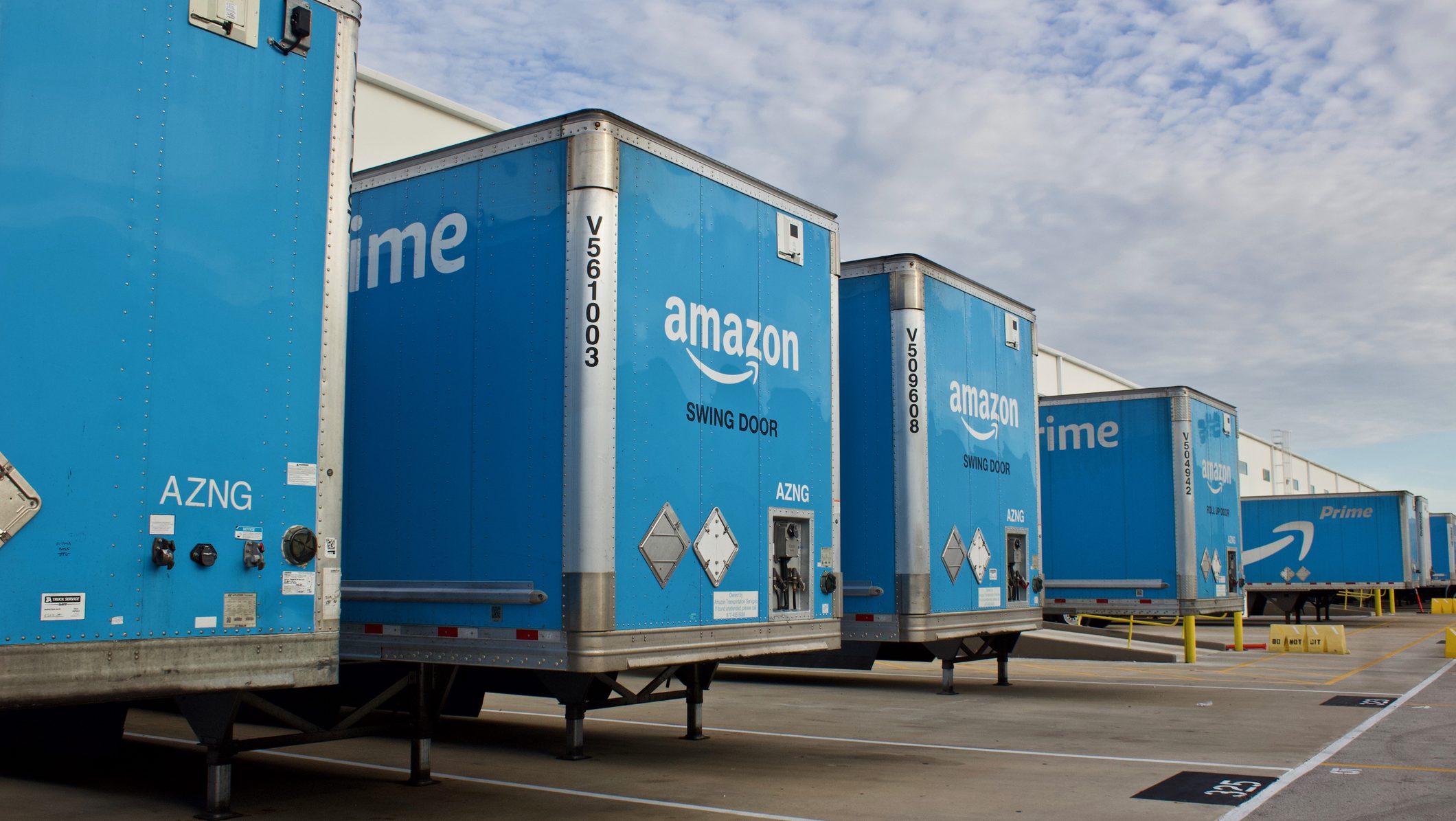
In May 2026, Amazon opened its logistics network to everyone. Amazon Supply Chain Services (ASCS) makes the company’s freight, warehousing, fulfillment, and parcel-delivery capabilities available to any business, not just sellers on the Amazon store. The early roster of ASCS customers is illustrative:
- Procter & Gamble and 3M use Amazon freight to move raw materials and finished goods through their own distribution networks.
- Lands’ End draws on a unified inventory pool to fill orders across multiple sales channels.
- American Eagle Outfitters ships orders placed on its own American Eagle and Aerie websites through Amazon’s parcel network.
Amazon CEO Andy Jassy described the move as similar to Amazon’s strategy with Amazon Web Services (AWS), when it extended its internal cloud infrastructure to enterprises and became a popular cloud provider worldwide. As a business strategy, it makes sense for a company that has built world-class infrastructure for itself to rent that infrastructure to others. Following the same playbook that transformed Amazon’s internal computing operation into a huge revenue generator as AWS, for another internal infrastructure around shipping has obvious profit-maximization appeal.
The fact that Amazon believes it can earn more from offering its logistics network to third parties than it can gain from denying competitors access strongly suggests that Amazon remains committed to Jeff Bezos’ virtuous cycle strategy first sketched out in 2001.
Amazon’s Virtuous Cycle Strategy Applied to Logistics
Amazon ASCS is now selling fulfillment at scale to third parties, including firms that compete with it, and even for uses unrelated to Amazon’s marketplace. Why would Amazon provide fulfillment services to competitors for uses unrelated to Amazon’s marketplace? Because Amazon’s longstanding virtuous cycle strategy makes it profit-maximizing to do so.
Start with the core elements of the virtuous cycle strategy sketched out by Jeff Bezos decades ago for Amazon’s Marketplace:
- Lower prices draw more customer traffic;
- More traffic attracts more third-party sellers;
- More sellers widen selection;
- A wider selection improves the customer experience and attracts even more traffic.
- More traffic creates economies of scale, leading to lower prices, so return to the top.
Growth across that loop lowers Amazon’s cost structure through economies of scale, which feeds back into lower prices. The whole strategy is self-reinforcing.
Amazon followed the same strategy with AWS when it externalized internal compute and storage into a cloud product sold to everyone, including competitors, and the strategic logic maps cleanly onto Bezos’s original virtuous cycle.
Selling fulfillment at scale to third parties plugs into that loop through several reinforcing channels, driven by a combination of (1) utilization efficiencies from amortization of fixed costs, and (2) economies of density. Putting both effects in the same virtuous cycle:
- Selling fulfillment to third parties raises network utilization
- Higher utilization spreads fixed costs across more volume, cutting average cost
- Lower average cost lets Amazon cut logistics prices
- Lower prices pull in more third-party volume
- More volume concentrates package density, cutting marginal cost per delivery
- Falling costs and rising volume justify further investment in capacity
- More capacity means more network to fill, so return to the top.
The first half of the logistics virtuous cycle works because logistics and fulfillment are capital intensive. Warehouses, robotics, middle-mile transport, last-mile delivery, and the software orchestrating all of the above are mostly fixed costs for a given geography. If you have spare logistics capacity, the fixed costs are spread among less quantity demanded, and the price of logistics services is higher. Selling spare capacity to third parties raises throughput and utilization, spreading those fixed costs, which drives down unit cost across your entire network.
The second half of the virtuous cycle works because logistics benefits from economies of density. The more packages moving through a single network in a given geography, the lower the cost and the faster the delivery for each one. Pulling competitors’ volume into the network increases package density, which improves speed and cost for everyone in it.
This is virtuous not only for Amazon, but also for its competitors purchasing logistics services from Amazon, who benefit from reductions in their own logistics costs. It is rational for Amazon to help its competitors reduce their costs, because Amazon’s own costs fall as a result, and Amazon profits from the increasing quantity of parcels moving through its logistics network.
For example, American Eagle is not being routed onto the Amazon store, but rather Amazon is delivering orders that American Eagle’s customers place on American Eagle’s own website. Similarly, Lands’ End is using Amazon’s network to serve channels of its choosing. Procter & Gamble and 3M are not retail rivals, but rather they are manufacturers using Amazon to move goods through distribution systems that have nothing to do with the Amazon store. Amazon rationally provides logistics services to both competitor and non-competitor third parties, because it is in Amazon’s interest to maximize the volume in its logistics network.
Competitors and Contestability Discipline ASCS Terms
One possible concern from competitors is that opening a network at a price is not necessarily the same as relinquishing the advantage the network confers. In principle, a firm can monetize an asset by selling access to competitors while preserving downstream dominance. What matters is whether the terms of access are set so that a competitor using ASCS cannot undercut Amazon’s own retail prices.
In practice, ASCS logistics terms are constrained by the existence of competitors and the contestability of the market. ASCS is selling into a logistics sector that already contains large, capable, independent alternatives. In addition to the U.S. Postal Service, UPS and FedEx are major private sector incumbents providing services across a huge geographic footprint. So long as an ASCS customer can buy fulfillment and logistics services from competitors capable of providing service at scale across a wide geographic footprint, ASCS will not be able to demand terms that prevent efficiently operated rivals from competing effectively with Amazon’s store.
The legacy carriers are formidable: UPS and FedEx each earn far more parcel revenue than Amazon, together roughly two-thirds of the parcel revenue in recent industry estimates, and they dominate the sector for heavier commercial freight shipments that manufacturers like Procter & Gamble and 3M actually move. Amazon’s typical package, built for lightweight residential, consumer product focused e-commerce, weighs a fraction of what the legacy carriers’ does. Meanwhile, the fastest-growing segment is neither Amazon’s ASCS nor the incumbents but the field of alternative carriers, whose volumes have lately grown at double-digit rates as shippers spread their business across more providers. Pitney Bowes, which has tracked the sector for a decade, concludes that parcel carrier disruption is increasing, and that is good news for parcel shippers. In other words, entry and scale-up by firms other than Amazon’s ASCS is both possible and actually happening, demonstrating ongoing contestability in the parcel segment.
Step back from the parcel segment to logistics as a whole, and the fragmentation is even clearer. Armstrong & Associates, which has measured the U.S. third-party logistics sector since 1994, describes the sector as highly fragmented and underpenetrated. Logistics is a multi-hundred-billion-dollar sector populated by thousands of freight forwarders, contract warehousing firms, brokers, and regional carriers, with no single provider in a position to control it. This is the sector into which ASCS sells, and a prospective customer who finds Amazon’s terms unattractive, whether on price or on the prospect of handing shipment and inventory data to a competitor, has multiple places to go at scale. That outside option strongly disciplines the terms.
The outside options and broader logistics sector contestability also answer any potential rent-extraction objection. A supplier can extract rent from buyers only up to the value of their next-best alternative. Where the alternatives are robust, the potential rents to be extracted are limited. The logistics input sector is not Amazon-shaped: a buyer’s next-best options are independent firms with their own scale, which is a structural fact that prevents Amazon from pricing ASCS to foreclose without watching customers walk. Absent major logistics sector (or at least parcel segment) consolidation, the existing competitors and ongoing contestability will discipline the terms of access to ASCS. So long as the terms of access to ASCS are so disciplined, opening the network is very unlikely to occur on terms that can plausibly harm competition.
Implications for the Antitrust Case and Potential Remedies
In September 2023, the Federal Trade Commission and a coalition of state attorneys general sued Amazon. At the center of their antitrust case is a claim about logistics: Amazon, they argue, pressures independent sellers on its marketplace to use Amazon’s logistics and fulfillment network as the practical price of being likely to win the Buy Box and qualify for Prime. Amazon’s fulfillment network, in the plaintiffs’ account, purportedly operates as a moat and as a lever: a way to lock sellers in, to raise their costs, and to deny rival marketplaces and rival logistics providers the volume they would need to reach competitive scale. The case largely survived Amazon’s motion to dismiss in 2024 and the core monopolization claims are now headed for a bench trial set for March 2027.
Amazon opening its logistics network to rivals does not necessarily invalidate antitrust enforcers’ claims about historical conduct; but it does make the plaintiffs’ claims less likely to be relevant going forward. In a scenario where the plaintiffs obtain a favorable ruling on some of their claims, the launch of ASCS has significant implications for potential remedies. As the District Court recognized in U.S. v. Microsoft, “[relief] should be tailored to fit the wrong creating the occasion for the remedy.” In other words, antitrust remedies should address current market conditions, rather than historical ones.
As Amazon’s conduct has evolved, any proposed remedy must be tested primarily against current conduct and market conditions, rather than being designed solely based on the conduct and market conditions at the time the complaint was filed. A theory of harm built around a fulfillment network as a closed, purportedly coercive moat now has to account for that same network being sold, openly and into a competitive market, to the firms the theory says it forecloses, including for use on sales channels unrelated to Amazon’s store. Perhaps most importantly, it suggests that a fulsome remedy to the historical foreclosure allegations could be a commitment to maintain open access to ASCS for rivals on competitive terms for at least a specified time period.
Such a targeted conduct remedy would address the concerns stated about historical Amazon conduct far more directly than structural remedies that would likely eliminate efficiencies, increase operating costs, and, in turn, impose higher prices on customers.


