


Critics of the technology sector have asserted as recently as 2020 that digital markets are stagnant, closed to entry, and low on competitive investment and that AICOA is “critical to reversing these trends by unlocking competition online.” The data tell an emphatically different story. Since 2020, the United States has experienced the largest surge of new business entry, private investment, and technological innovation in the tech sector’s history, and quite possibly in the history of any American industry.
The epicenter is artificial intelligence, where new entrants founded no earlier than 2015 and, in several prominent cases in the past five years, now approach trillion-dollar market valuations. IPO investors reportedly value Anthropic at $2 trillion, which is a meteoric rise for a company founded in 2021. Hyperscale tech infrastructure investment has become a key driver of national GDP growth, and adoption by businesses and consumers is proceeding faster than any prior general-purpose technology in human history. AI quality is improving at record speeds, and AI is now helping humans solve longstanding hard problems in mathematics and the sciences. Over the same period, new business entry is at record highs, driven largely by tech-related activities.
A Historic Rising Tide of New Businesses
Start with the broadest measure of entry available: applications to start new businesses. U.S. Census Bureau Business Formation Statistics show that Americans have been filing new business applications at rates far above pre-2020 norms throughout this period. There were roughly 447,000 applications in May 2025 alone, roughly half again the monthly pace that prevailed before 2020. New business applications rose to nearly 524,000 in May 2026. By May 2026, high-propensity U.S. business applications (those most likely to become employers with payrolls) were also nearly one and a half times as high as they had been before 2020.

Prominent examples of new businesses are most visible at the technological frontier:
- The oldest of the major new AI companies, OpenAI, was founded in late 2015, and by March 2026 it raised $122 billion in committed capital at a post-money valuation of $852 billion.
- Anthropic did not exist before 2021; by May 2026, Forbes reported it had reached a roughly $30 billion annualized revenue run rate, up from $1 billion just fifteen months earlier, and Anthropic reported raising $65B in Series H funding at a $965B post-money valuation.
- xAI, founded in 2023, closed one of the five largest venture rounds ever recorded in Q1 2026.
- Beyond the frontier labs, more than a dozen U.S. companies raised venture capital funding rounds of $1 billion or more in Q1 2026 alone, spanning generative and physical AI, autonomous vehicles, semiconductors, data centers, robotics, and defense.
Breaking New Investment Records
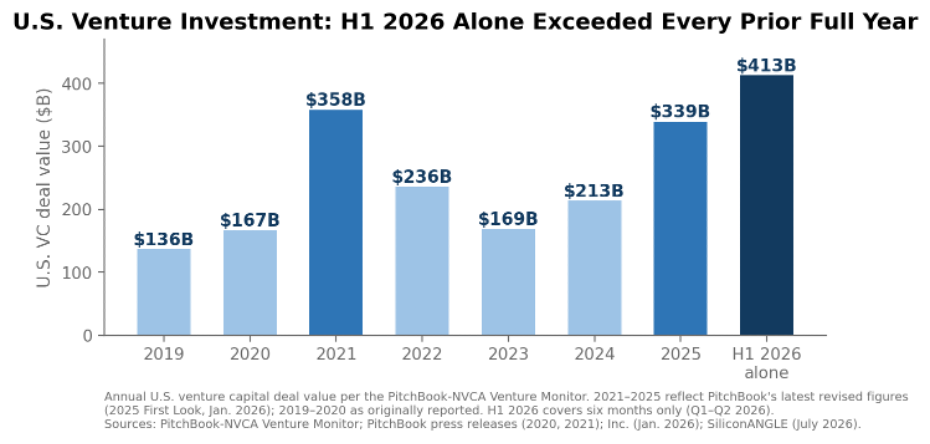
U.S. venture investment has shattered every record on the books. According to the PitchBook-NVCA Venture Monitor, U.S. venture capital deployed $412.7 billion in the first half of 2026, which is nearly 30% more than the entirety of 2025, with $355.9 billion (86%) going to AI companies. Crunchbase data show U.S. companies captured 83% of global venture capital in Q1 2026, up from historical norms below half, and CB Insights reports U.S. startups raised $328 billion in 2025, which was about 70% of global funding. The 2026 Stanford AI Index found U.S. private AI investment reached $285.9 billion in 2025, more than 23 times the $12.4 billion invested in China. The United States also led the world in AI entrepreneurship, with 1,953 newly funded AI companies in 2025, more than 10 times the next closest country.
The full PitchBook-NVCA annual series puts the investment boom in perspective: U.S. venture deal value stood at $136.5 billion in 2019, climbed to a then-record $358.2 billion in 2021, reached $339.4 billion in 2025, and the first half of 2026 alone exceeded every prior full year on record.
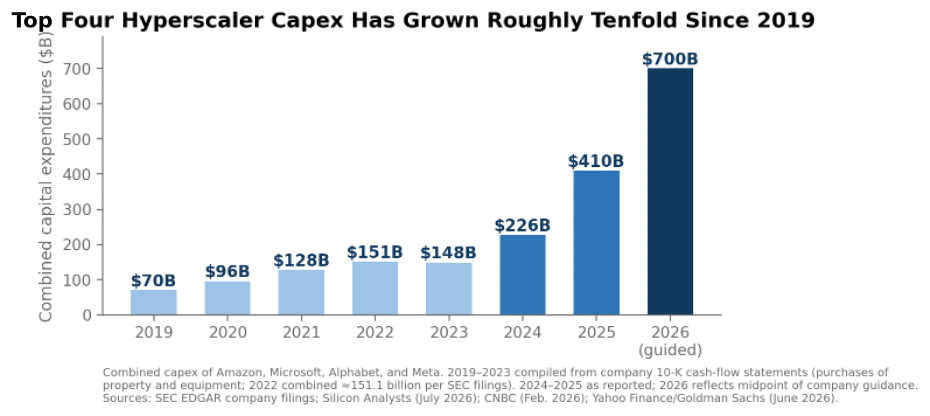
The four largest U.S. hyperscalers (companies that operate data center infrastructure at enormous scale) invested a record $410 billion in capital expenditures in 2025. The midpoint of company guidance comes to about $700 billion in 2026, overwhelmingly for AI data centers, chips, and networks. Goldman Sachs now projects $5.3 trillion in combined capex from these four companies between fiscal 2025 and 2030. The same four companies spent roughly $70 billion in 2019 and $151.1 billion in 2022, meaning 2026 spending guidance represents about a tenfold increase over 2019.
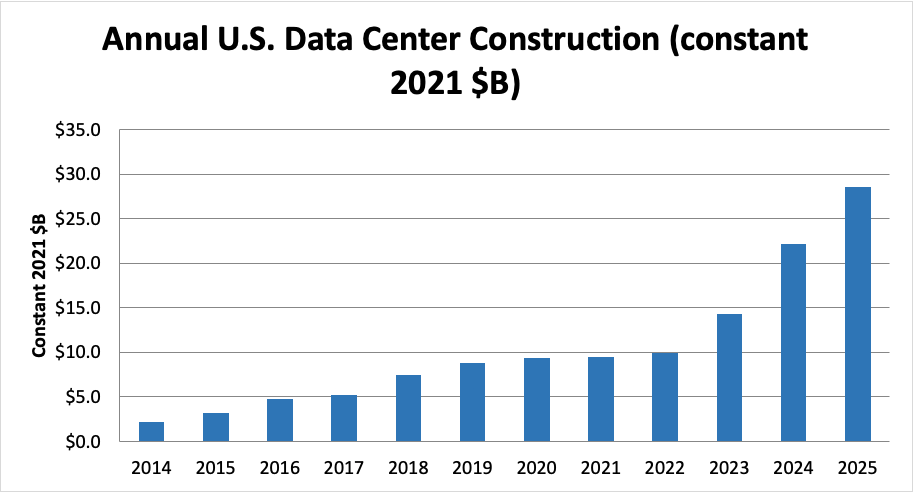
The physical buildout is visible across the country, and official construction statistics reflect it. Census Bureau data shows private data center construction reached an annualized rate of $50.7 billion in April 2026, up 28% year over year. For the first time, private data center construction exceeds both general office construction and all public spending on transportation infrastructure.
The underlying Census series shows annual data center construction more than tripled in real terms between 2019 and 2025, from roughly $8.8 billion to $28.6 billion in constant 2021 dollars. <onthly spending nearly tripled since late 2022 alone. Data centers rose from 12.8% of all private office construction in 2021 to 45.7% by March 2026.
These investments are materially moving the national economic accounts. AI-related investment categories such as information processing equipment, software, R&D, and data centers contributed roughly 0.97 percentage points to real GDP growth in the first three quarters of 2025, accounting for 39% of total GDP growth, exceeding the tech sector’s 28% share at the height of the dot-com boom in 2000. S&P Global estimates data center and related technology investment accounted for 80% of the growth in U.S. private domestic demand in the first half of 2025, and the Bank for International Settlements finds total U.S. IT-related investment has risen to 5% of GDP, exceeding its previous peak during the dot-com boom.
By contrast, the European Union, which implemented sweeping ex-ante regulation of targeted digital markets and services between 2020 and 2024, has seen investment decline. EY reports that “Foreign direct investment (FDI) declined 7% in Europe in 2025” and “foreign direct investment (FDI) in Europe [] decline[d] 5% to a nine-year-low in 2024. The number of jobs created by FDI declined 16% year on year.”
Unprecedented Tech Innovation at the Frontier
The most striking feature of the post-2020 landscape is that the AI frontier is contested by firms that are new or newly transformed.
- OpenAI’s ChatGPT, launched in late 2022, now serves more than 900 million weekly users, with the company generating roughly $25 billion in annualized revenue as of February 2026 and valued at $852 billion after its March 2026 funding round. This is among the fastest consumer product adoption curves ever recorded.
- Anthropic, a 2021 entrant whose Claude AI was not released until 2023,, surpassed OpenAI in annualized revenue in April 2026, with approximately 85% of its revenue from enterprise and developer customers and more than 1,000 enterprise clients each spending over $1 million annually.
Public markets are validating the innovation pipeline. AI chipmaker Cerebras went public in 2026 at a $34.3 billion valuation with shares opening at more than double the offer price, and both OpenAI and Anthropic have confidentially filed to go public. Meanwhile, competition among model developers is intense, and leadership churns rapidly: Menlo Ventures estimates OpenAI’s share of enterprise LLM spending fell from 50% in 2023 to 27% in 2025, while Anthropic rose to 40% and Google reached 21%. A market in which a five-year-old entrant can dethrone the incumbent category leader in enterprise share within three years is the textbook example of a contestable market.
Moreover, this innovation is producing real results. AI tools are helping mathematicians solve multiple longstanding problems. A July 2026 Federal Reserve analysis notes that micro-level experiments consistently find productivity gains from AI tools, and the Stanford HAI AI Index finds knowledge workers using AI save a median of at least 5% of weekly work hours.
The Dynamic 2020s
Business formation, venture investment, capital expenditure, construction, GDP contribution, firm adoption, and market-share churn all show that the U.S. technology sector has experienced perhaps its most dynamic period since 2020. New entrants founded after 2020 are outcompeting incumbents. We are on the verge of multiple new trillion-dollar companies, most of which are just a few years old, and the oldest of which is just over a decade old. Tech investment has literally never been higher. Most promising of all, the United States is capturing the overwhelming majority of global AI investment, including real, tangible investment in new infrastructure, buildings, and computational resources.
Policymakers operating under the mistaken assumption that digital markets are static or uncompetitive must update their priors in light of this record. The evidence shows a contestable tech sector characterized by unprecedented entry, investment, and innovation. In other words, competition is working.