Washington – The Computer & Communications Industry Association is raising concerns about SB 2761, “Relating to Social Media,” and SB 3001, “Relating to Artificial Intelligence,” both under consideration today before the Hawaii House Committee on Judiciary and Hawaiian Affairs. CCIA opposes both bills, citing constitutional concerns, privacy risks, and significant compliance challenges for digital services.
CCIA warns that SB 2761 raises serious First Amendment concerns by restricting access to lawful speech and potentially requiring age verification systems to collect sensitive personal data. Courts have repeatedly found that similar requirements violate constitutional protections and fail to demonstrate a clear link between social media use and harm to minors. The association also notes that vague definitions and broad coverage standards create uncertainty for businesses while undermining privacy protections for users of all ages.
With SB 3001, CCIA notes that the bill’s broad and subjective definition of “conversational artificial intelligence” could sweep in a wide range of commonly used tools, including customer service chat functions, productivity software, and educational applications. The association warns that unclear standards could create compliance challenges for businesses and limit access to widely used technologies, while emphasizing that existing industry standards already address many safety considerations.
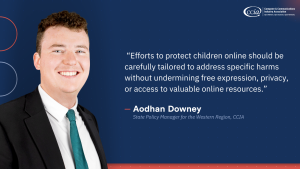
The following statement can be attributed to Aodhan Downey, State Policy Manager, West Region at CCIA:
“Taken together, these bills create a framework that raises serious constitutional concerns while introducing vague and unworkable requirements for digital services. SB 2761 risks restricting access to lawful speech and encouraging the collection of sensitive personal data, while SB 3001 casts an overly wide net that could capture everyday technologies people rely on. Policymakers should focus on targeted solutions that protect users without undermining privacy, limiting access to information, or creating uncertainty for businesses trying to comply with the law.”