Washington – The Computer & Communications Industry Association will testify today before the Connecticut Joint Committee on General Law on a social media age verification bill. CCIA will caution that HB 5037’s broad requirements on social media platforms could create significant compliance challenges and legal uncertainty for companies operating in the state. While the association supports thoughtful approaches to online youth safety, it warns that several provisions in the bill may be overly prescriptive and difficult to implement across modern digital services.
HB 5037 would regulate platforms that recommend or prioritize user-generated content. The bill restricts the use of personal or device information to recommend content to minors unless age verification or parental consent requirements are met. The bill also mandates the immediate deletion of data collected for age verification, requires recurring health warnings about the mental health risks of social media, limits the timing and frequency of notifications sent to minors, establishes default privacy and content restrictions, and allows parents or guardians to further control their child’s online experience.
CCIA is particularly concerned that the bill’s age verification framework and design mandates could impose rigid technical requirements on rapidly evolving online services. The association cautions that broad restrictions on recommendation systems and data use may create unintended barriers to providing safe, age-appropriate experiences, while increasing compliance burdens for platforms that operate across multiple states with differing standards.
The association supports balanced, risk-based approaches that protect young users while providing clear, workable guidelines for companies. CCIA will encourage lawmakers to pursue policies that are technologically feasible, promote online safety, support innovation, and avoid creating a fragmented patchwork of state-by-state requirements that could limit access to beneficial digital tools.
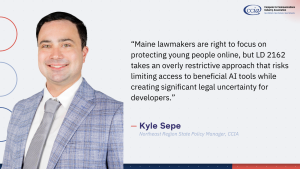
The following statement can be attributed to Kyle Sepe, Northeast Region State Policy Manager for CCIA, who will testify against the bill today:
“CCIA firmly believes that children are entitled to security and privacy online. Our members have designed and developed parental tools to individually tailor younger users’ online use to their developmental needs. However, protecting children from harm online does not include a generalized power to restrict ideas to which one may be exposed. Lawful speech cannot be suppressed or compelled.”