
AT&T asserts that acquiring T-Mobile will allow it to roll out its next-generation wireless network. However, what they don’t say is that the potential merger will actually delay, rather that precipitate AT&T’s (and T-Mobile’s) investment and expansion of its next-generation wireless network.
The reasons for this are many. First, the financial facts of the merger make it readily apparent that it will be several years before a merged AT&T/T-Mobile actually makes any significant investments to deploy next-generation mobile, much less expand that access to the 95 percent of Americans that its public relations campaign touts.
Why? Because the rationale for any horizontal merger is to achieve cost-savings through synergy and increased efficiency. For those benefits to be realized, the merged companies will work to eliminate network redundancies. This means that until regulators give the thumbs-up, neither network will likely invest in any additional build-out for worry that such efforts would be redundant.
Second, build-out will likely be further delayed for years until the companies are able to figure out how to integrate their networks, systems, customers, etc.
Third, AT&T is borrowing $25 billion from JP Morgan, through a one-year loan, to finance the purchase of T-Mobile. Thus, AT&T will be on the hook to repay the $25 billion in 2012; suffice it to say, AT&T isn’t likely to be investing much in expanding its network until that loan is repaid.
Expecting AT&T to roll out a 4G network at the same time as it repays $25 billion, integrates operations, and tries to squeeze every last dollar of efficiency gains out of the deal is fantasy. Anyone who has ever experienced the dropped calls, slow data service, and poor customer service that epitomize the AT&T experience knows the company struggles to get even those fundamentals right – expecting it to do so much more and accomplish it simultaneously is a pipe dream.
News

April 1, 2026
CCIA Warns Alaska Social Media Bill HB 318 Raises Serious Constitutional and Privacy Risks
Washington – The Computer & Communications Industry Association is raising concerns about HB 318, legislation currently under consideration in the Alaska House that would regulate minors’ soci...
News
April 1, 2026
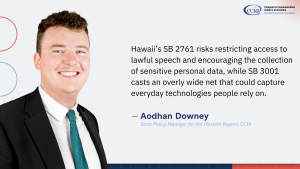
CCIA Raises Constitutional and Compliance Concerns with Hawaii Bills SB 2761 and SB 3001
Washington – The Computer & Communications Industry Association is raising concerns about SB 2761, “Relating to Social Media,” and SB 3001, “Relating to Artificial Intelligence,” both un...
News

April 1, 2026
CCIA Raises Privacy and Compliance Concerns with Maryland Bills SB 932 and HB 883
Washington – The Computer & Communications Industry Association is raising concerns about SB 932 and HB 883, both under consideration today in Maryland legislative committees. CCIA opposes both ...
