
How should the government free up bandwidth and balance the interests of those involved? Panelists weighed in at a Brookings Institution event Wednesday “A Framework for Innovative Federal Spectrum Policy.”
Panelists including James Cicconi of AT&T, Blair Levin of the Aspen Insitute, Adele Morris of the Brookings Institute, Richard Whitt of Google, and Roger Entner of Recon Analytics agreed that the wireless broadband market is facing a “spectrum crunch.” They offered their thoughts on what the demand will mean for the prospects and outcomes of any future spectrum incentive auction as mobile broadband providers compete for spectrum.
Cicconi said part of AT&T’s move to buy T-Mobile was motivated by its short-term need for spectrum. However, Cicconi failed to comment on whether AT&T’s possible acquisition will delay action on incentive auctions by Congress, the FCC, and broadcasters due to the fact that eliminating one major potential bidder from the auction marketplace (T-Mobile) and filling AT&T’s short-term demand with T-Mobile’s spectrum would make an auction less financially rewarding to both broadcasters and the Treasury.
CCIA believes that AT&T’s strategy is to fill its short-term spectrum needs through acquisition in the short-term. While the competitors of the Verizon/AT&T duopoly fade as a result of reaching spectrum exhaustion, AT&T will bide its time until a spectrum auction occurs well down the road. At such a time, there will be fewer bidders for the auctioned spectrum, which will allow AT&T to purchase spectrum at a bargain basement price. This strategy will enrich AT&T and its shareholders to the detriment of taxpayers; consumers in the wireless marketplace; innovation in the design of handsets, operating systems, and mobile applications; and competition in the mobile sector.
CCIA agrees with assertions by Levin spectrum is a competition issue. There needs to be enough spectrum freed up in order to allow competition to flourish. Greater competition between firms is what drives the efficient uses of spectrum. Freeing up spectrum only to see it purchased by the AT&T/Verizon duopoly does not solve the needs of consumers.
Consumers need robust competition in the mobile marketplace. Competition drives real innovation in pricing, devices, services, and applications. Without competition, transferring spectrum from broadcasters to incumbent mobile providers will continue to be a wasteful misallocation of vital public resources.
Whitt of Google put it best, unfortunately, with his outlook on the potential for a spectrum incentive auction to spur new entrants into the mobile marketplace. Whitt, recalling Google’s attempt to purchase spectrum during a 2008 incentive auction, surmised that incumbents will always outbid new entrants – the spectrum is much more valuable to incumbents. Incumbents have everything to lose by allowing a potentially strong competitor to enter the market, so it’s cheaper to overpay for spectrum than to actually compete in the marketplace.
News

April 1, 2026
CCIA Warns Alaska Social Media Bill HB 318 Raises Serious Constitutional and Privacy Risks
Washington – The Computer & Communications Industry Association is raising concerns about HB 318, legislation currently under consideration in the Alaska House that would regulate minors’ soci...
News
April 1, 2026
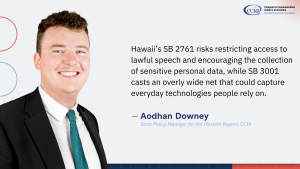
CCIA Raises Constitutional and Compliance Concerns with Hawaii Bills SB 2761 and SB 3001
Washington – The Computer & Communications Industry Association is raising concerns about SB 2761, “Relating to Social Media,” and SB 3001, “Relating to Artificial Intelligence,” both un...
News

April 1, 2026
CCIA Raises Privacy and Compliance Concerns with Maryland Bills SB 932 and HB 883
Washington – The Computer & Communications Industry Association is raising concerns about SB 932 and HB 883, both under consideration today in Maryland legislative committees. CCIA opposes both ...
